


Jasper After the 2024 Wildfire: What the Rivers Look Like in 2026
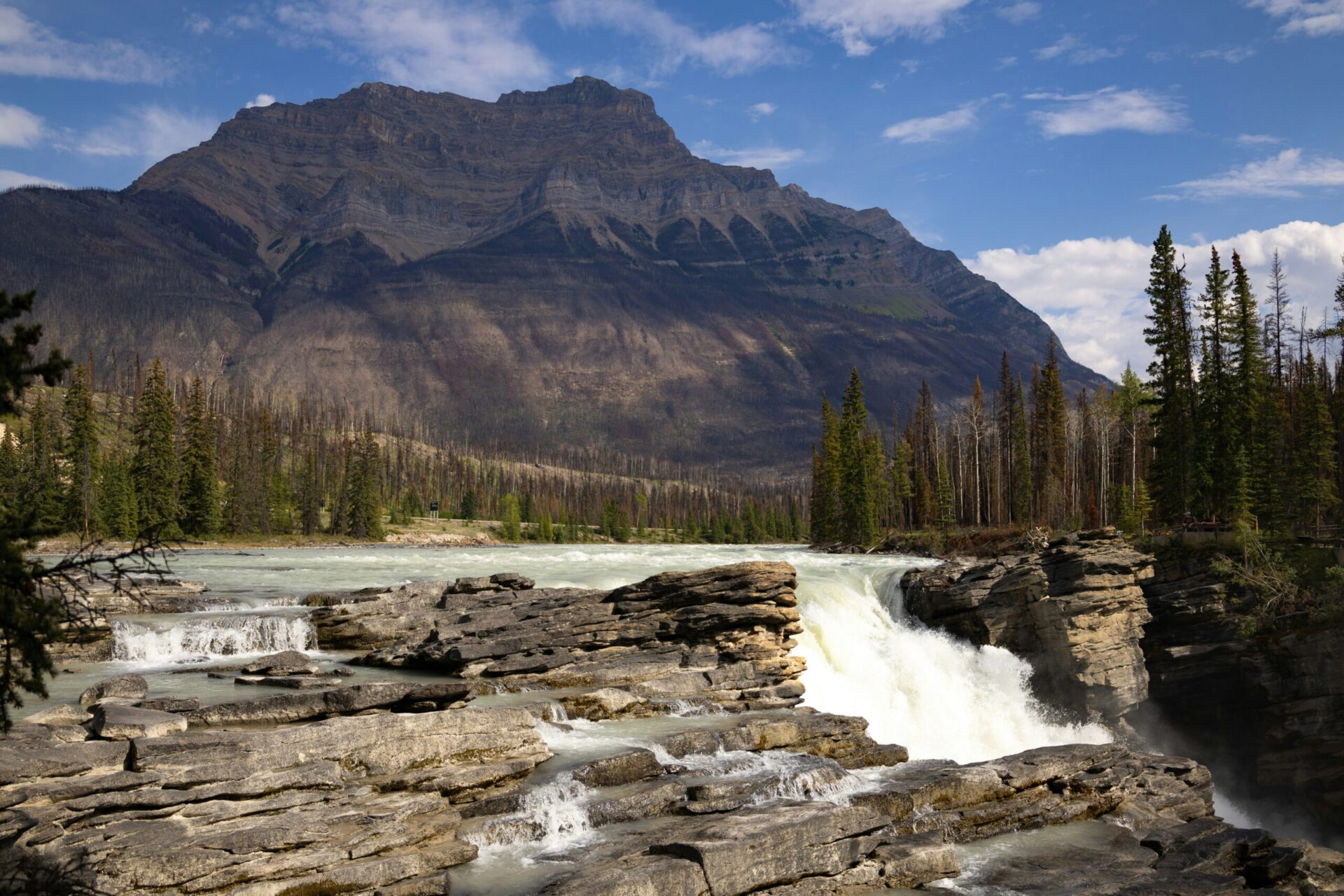
We have been running rafts on the Athabasca and Sunwapta rivers since the 1970s. We have seen spring floods, record snowpacks, drought years, and everything in between. In July 2024, we watched smoke fill the Athabasca Valley as the most significant wildfire in Jasper National Park’s recorded history tore through roughly 30 percent of the park and damaged a large portion of the townsite we have called home for over five decades.
Since then, we have received a steady stream of emails and phone calls from guests asking some version of the same question: “Is rafting still worth doing after the fire? Is the river okay? Is Jasper even open?”
We want to answer those questions directly, honestly, and with the perspective of an operator who has been on the water through all of it.
TL;DR: Rivers cannot burn. The Athabasca and Sunwapta rivers were completely unaffected by the 2024 wildfire. We ran a full season of trips throughout 2025. Jasper is open. The landscape is visually striking in ways you would not expect. Wildlife sightings are up. Come raft with us.
What the 2024 Jasper Wildfire Actually Was
We are not going to minimize what happened. The 2024 Jasper wildfire was a catastrophic event by any measure.
Fires ignited north and south of the Jasper townsite in late July 2024 and grew rapidly under extreme weather conditions. On July 22, all 25,000 residents, workers, and visitors were evacuated. By the time Parks Canada declared the fire under control in September 2024, it had burned approximately 32,700 hectares, roughly 30 percent of Jasper National Park. The fire was officially declared extinguished on April 1, 2025.
The townsite itself suffered serious damage. Entire blocks were lost. Hundreds of homes and dozens of businesses burned. Residents returned to find streets they had walked for years unrecognizable. The human toll, both economic and emotional, has been real and ongoing.
We say all of this because we think honesty matters. Jasper is in recovery. The townsite is rebuilding. Some areas of the park remain closed. None of that is hidden or minimized here.
But here is the thing that a lot of people do not fully understand when they picture the word “wildfire” and then picture the Athabasca River: those two things have almost nothing to do with each other.
The Rivers Were Not Touched. Not One Bit.
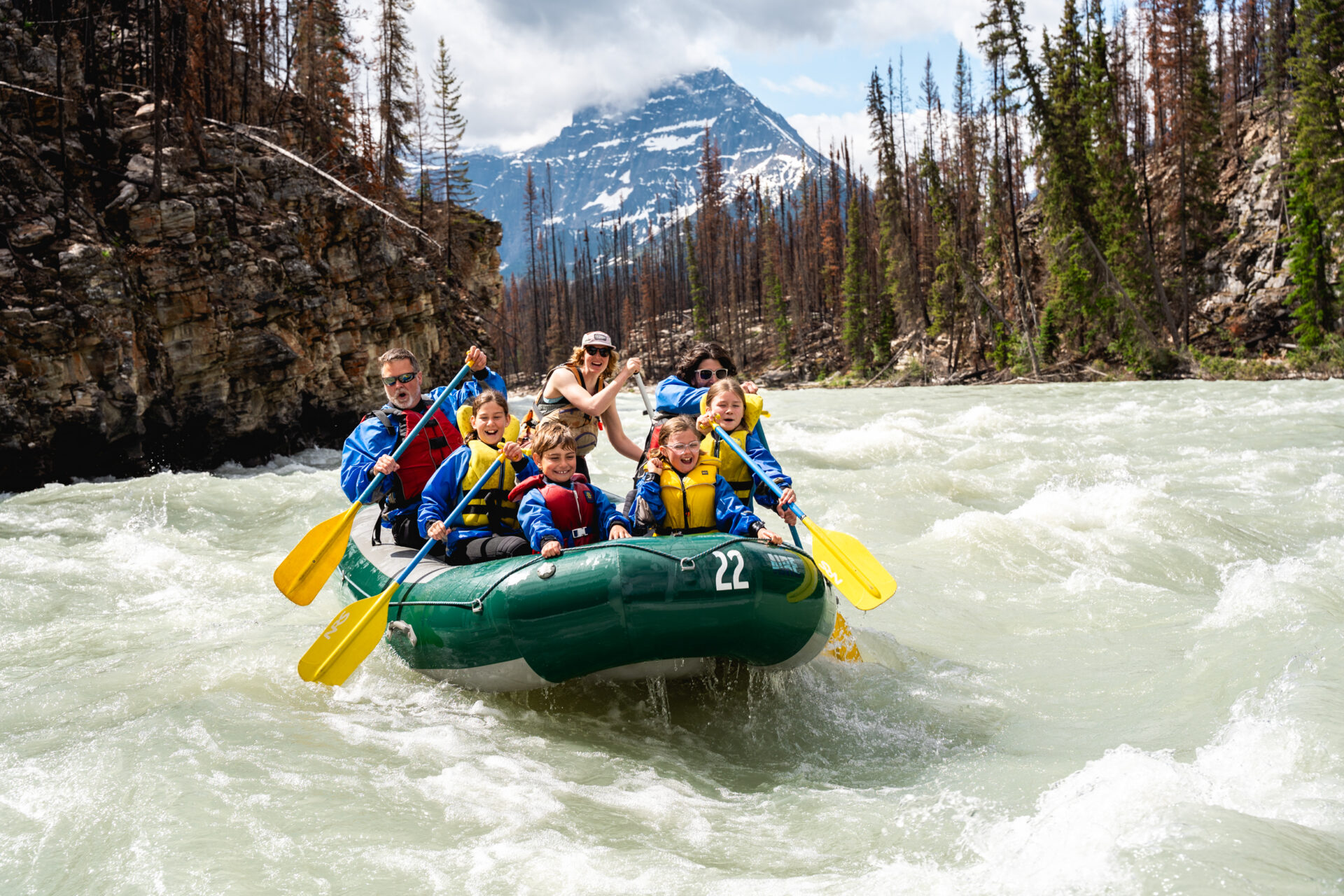
We want to be as clear as we can possibly be about this: rivers cannot burn.
Water is water. The Athabasca River did not change course. Its flow was not disrupted. Its water quality was not compromised by the fire. The Sunwapta River, which feeds into the Athabasca from the Sunwapta Falls area south of town, was equally unaffected. The rapids are the same rapids. The canyon walls are the same canyon walls. The cold, clear glacially fed water that has made these rivers world-class rafting destinations for decades was flowing through the smoke just as it was before the smoke arrived.
During the evacuation and the weeks that followed, Parks Canada and other agencies monitored the Athabasca corridor closely. GPS tracking data from grizzly bears in the area showed that large mammals, including a well-known grizzly bear and her two cubs, took refuge along the Athabasca River during the fire itself. The river corridor was, quite literally, a sanctuary.
We launched our first trips of the 2025 season on schedule. Every trip we ran that summer was on a river in the same condition it has always been in. Guest reviews confirmed what we already knew: the water experience was exactly what people come to Jasper for. No smoke. No ash. No compromise.
For 2026, we are running all three of our trips as usual. Our Mile Five trip on the Athabasca is the same gentle Class II float it has always been, ideal for families and first-time rafters. The Athabasca Falls run brings Class II-III action through a more technical stretch of river. And the Sunwapta River trip remains our most challenging offering at Class III, for guests who want genuine whitewater.
What the Landscape Actually Looks Like From the Water in 2026
Here is where the story gets genuinely interesting, and where a lot of people are surprised by what we tell them.
A burned forest does not look like a wasteland. At least not for long, and not to eyes that take time to look carefully.
As your raft moves down the Athabasca, you pass through a landscape that is constantly shifting between zones. Some sections of the river corridor were untouched by the fire entirely, still dense with spruce, fir, and lodgepole pine. Other sections open up dramatically into burned areas where the standing black trunks of dead conifers create an almost sculptural silhouette against the mountain peaks. And threading through all of it, particularly in any burned section, is an explosion of colour: fireweed growing in vivid magenta columns, bearberry spreading low and green across the forest floor, wild strawberries, showy asters, and young aspen shoots pushing up from root systems that survived underground.
The visual contrast is genuinely dramatic in a way that photographs do not fully capture from land. From the water, at river level, with the Rockies behind it all, it is one of the more visually arresting landscapes we have floated through in five decades of guiding.
The open sightlines are also a photographer’s advantage that most visitors have not considered. Dense conifer forest is actually difficult to photograph wildlife in. The burned areas have removed that visual barrier entirely. If an elk is grazing 200 metres from the river in a burned section, you will see it. Before 2024, that same elk would have been invisible behind a wall of spruce.
This is not spin. This is ecology. And it plays out on the water in ways that regularly surprise our guests.
Wildlife After the Fire: More Visible Than Ever
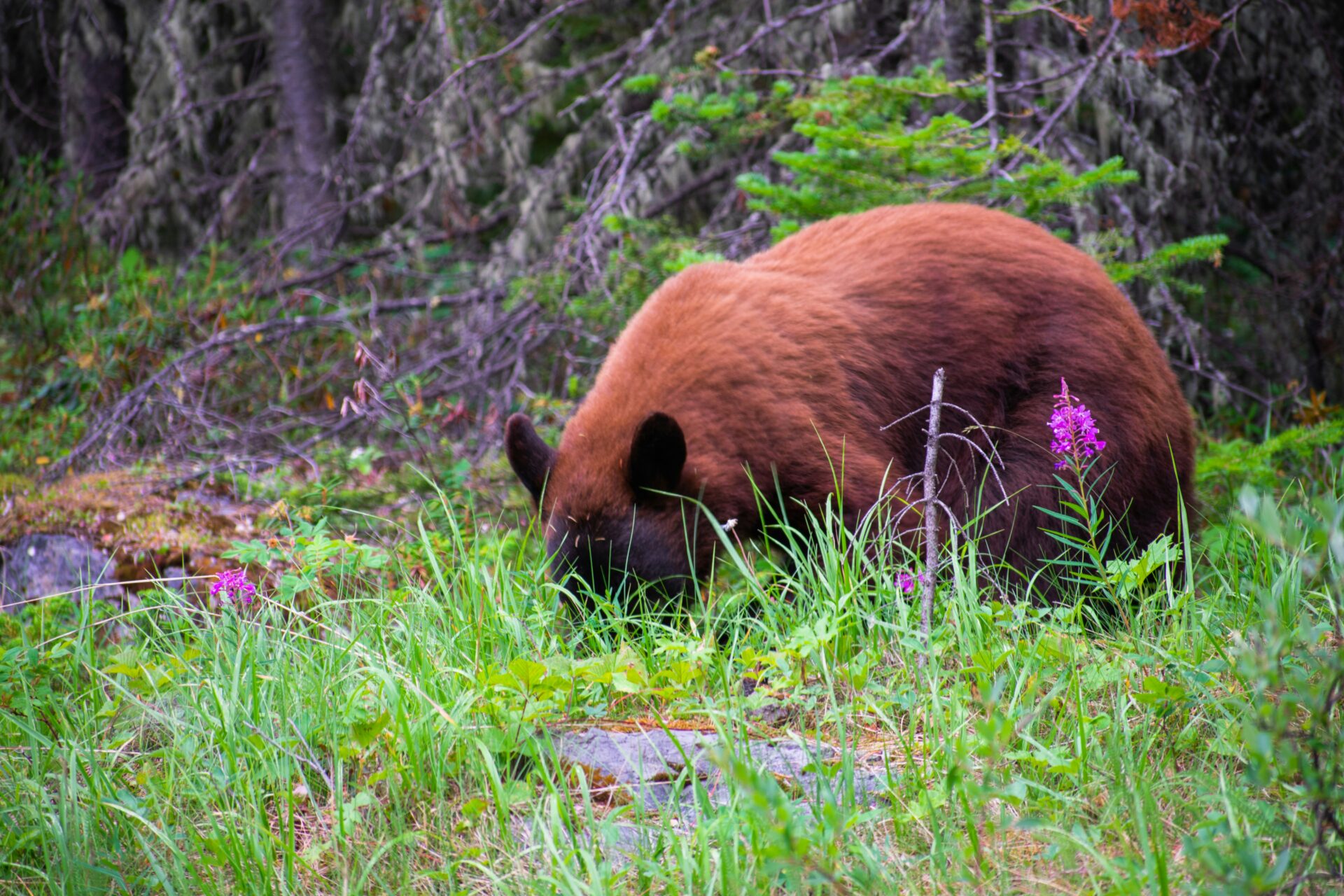
One of the most consistent things our guides have reported through the 2025 season is increased wildlife visibility, particularly in and near burned areas.
This is not coincidental. It is a well-documented ecological pattern known as the habitat edge effect. When a fire creates a boundary between burned open areas and intact forest, it concentrates wildlife along that edge. Animals that prefer open areas for foraging and intact forest for cover end up moving through and congregating at those boundaries in higher numbers than they would in either habitat alone.
Elk and deer moved back into burned zones within months of the fire, drawn by the abundance of new vegetation. Fireweed, in particular, is highly nutritious and one of the first plants to regenerate after fire. As a result, large ungulate herds are frequently visible from the river in areas they would not have been before 2024.
Bears, both black bears and grizzlies, are active throughout the Athabasca corridor. The river has always been good bear country. After the fire, with reduced forest density in burned sections, sightings have become even more frequent. Our guides have spotted grizzlies feeding in burned meadow areas that were previously dense forest.
Raptors including bald eagles and osprey, which follow the river year-round, are also easier to observe when the surrounding vegetation is lower and more open. For wildlife watchers, the post-fire landscape offers a genuinely different and often more productive experience than the pre-fire landscape did.
Parks Canada’s own research confirms this pattern. Their wildlife monitoring notes that species like elk, deer, and black bears adapt quickly and thrive in post-fire habitat. The Jasper corridor is seeing that play out in real time.
Jasper Townsite Recovery: Where Things Stand in 2026
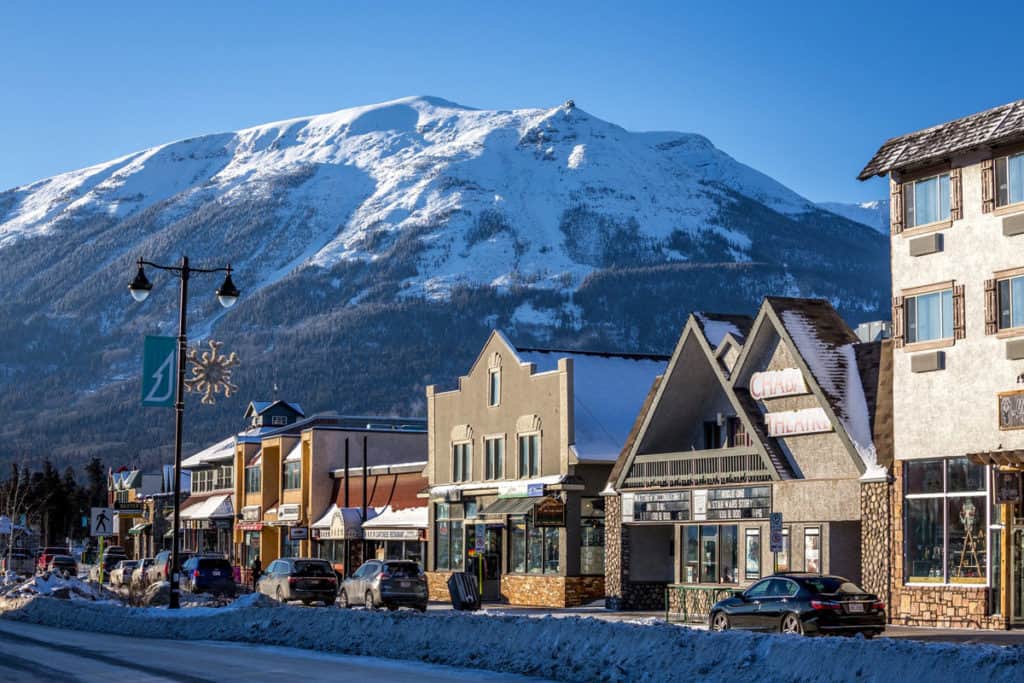
Jasper is a functioning, welcoming town in 2026. It is also a town in the middle of a major rebuild. Both of those things are true simultaneously, and understanding that context helps set accurate expectations.
On the accommodation side, more than 25 hotels and lodges are open and taking bookings. The Fairmont Jasper Park Lodge, one of the park’s most iconic properties, is fully operational. The Forest Park Hotel has even opened a new wing since the fire. Five additional properties including Maligne Lodge and Mount Robson Inn are in various stages of reopening. For visitors booking a trip to Jasper in 2026, accommodation availability is solid.
Restaurants and services are largely back. Over 70 restaurants are operating in town, including well-loved local spots like Bear’s Paw Bakery. Grocery stores are open. Gas stations are running. The infrastructure visitors need for a comfortable trip to Jasper is in place.
On the park side, major attractions are accessible. Maligne Lake is open. Miette Hot Springs is running. Pyramid Lake, the Columbia Icefield, and Maligne Road are all accessible. A number of day hiking trails have reopened, including the Whistlers Trail which returned in August 2025, and Parks Canada has announced that Valley of the Five Lakes is slated to reopen in 2026 after crews put in over 2,000 hours of trail restoration work.
Some closures remain. Edith Cavell Road and the Cavell Trail are closed for the foreseeable future. Maligne Canyon requires extensive geotechnical assessment before it can safely reopen. Trail 9c (the Tekarra Loop) also remains off-limits. Parks Canada’s interactive closure map is the most current resource for trail-by-trail status.
The rebuild is moving. Permits are being issued in under 20 days. Structures are coming out of the ground. Affordable housing is under construction. Jasper is not finished recovering, but it is a long way from the shuttered, uncertain place it was in the autumn of 2024. The energy in town is forward-looking, and the people who have rebuilt their businesses are genuinely glad to see visitors come back.
Our own shop at 618C Connaught Drive is open from 8AM to 6PM, May through September, as it has been every year since we started. Nothing about that has changed.
The Silver Lining: What Post-Fire Jasper Offers That Pre-Fire Jasper Did Not

We have thought a lot about how to talk about this honestly without sounding like we are putting a marketing gloss on a genuine tragedy. What we can say is this: the 2024 wildfire was devastating for a lot of people and for parts of this landscape. That is true. And there are things about the recovering landscape of 2026 that are genuinely remarkable to witness, and that visitors who come right now will experience in a way that visitors who wait another decade will not.
Ecological recovery after wildfire is one of the most dynamic processes in nature. What you are seeing from our rafts right now, in 2026, is a landscape in active transformation. The fireweed is at its most vivid in the first few years after a burn. The wildlife activity in the newly opened habitat edges is elevated in ways it will not be once the forest regrows. The visual drama of burned timber against mountain granite, with new green growth threading through it, is a scene that will change substantially every year.
Parks Canada has even launched a citizen science photography project along popular trails, asking visitors to take repeat photographs at fixed points to document the recovery. The recovery itself has become an attraction, a living classroom in landscape renewal that you can only see right now.
For photographers, post-fire Jasper offers compositions that have never existed before and that will not exist in the same form in ten years. Open vistas through previously forested terrain. Wildlife in the foreground, peaks in the background, burned snags as structural elements in the middle ground. It is a visually distinctive place to point a camera.
From a rafting perspective, we would argue that the combination of unchanged rivers, increased wildlife visibility, and the dramatic visual backdrop of a recovering mountain landscape makes 2026 one of the more interesting seasons we have offered. Not because of the fire. In spite of it, and because of what comes after.
Book With Confidence: Our 2026 Season Is Fully Open
We have been running trips on these rivers for over 50 years. We ran through the 2025 season without interruption. We are running the full 2026 season the same way we always have: professional guides, quality equipment, safe trips, and the same rivers that have been the best part of a Jasper visit for generations of guests.
If the wildfire has been making you hesitate, we hope this post has been useful. The short version is simple: the rivers are fine, Jasper is open, and the landscape right now is something worth seeing.
We operate May through September, 8AM to 6PM. You can reach us at 780-852-4292 or book directly online. We look forward to having you on the water.
Frequently Asked Questions: Rafting in Jasper After the 2024 Wildfire
Is rafting in Jasper affected by the 2024 wildfire?
No. The Athabasca and Sunwapta rivers were completely unaffected by the 2024 wildfire. Rivers cannot burn. We ran a full season of rafting trips in 2025 with no fire-related disruptions to the water or the experience on the river, and we are fully open for the 2026 season.
Is Jasper open for tourists in 2026?
Yes. Jasper is open and welcoming visitors in 2026. More than 25 hotels are operating, including the Fairmont Jasper Park Lodge. Over 70 restaurants are back in business. Major park attractions including Maligne Lake, Miette Hot Springs, the Columbia Icefield, and Pyramid Lake are all open. Some areas such as Edith Cavell Road and Maligne Canyon remain temporarily closed for safety assessment and restoration work. Parks Canada maintains a current interactive closure map for up-to-date trail and road status.
What does the landscape look like from the river after the wildfire?
From the river, you see a striking mix of burned forest and vivid new growth. Stands of blackened lodgepole pine rise against the mountain skyline while fireweed, bearberry, and bright green shoots push up from the forest floor. The open sightlines created by the burn actually make wildlife easier to spot. Elk and deer have moved back into burned areas to graze on new vegetation, and grizzly bears are frequently seen along river corridors. The visual contrast between burned and intact forest is genuinely dramatic from water level.
Is wildlife more visible in Jasper after the wildfire?
Yes, in many cases. The burned areas have created open habitat edges where wildlife congregates to feed on new vegetation. With the dense forest canopy gone in burned zones, elk, deer, bears, and other animals are much easier to spot from open areas and from the river. The regrowth is rich in plants like fireweed, strawberries, and showy asters that attract grazers. Our guides consistently reported more frequent wildlife sightings throughout the 2025 season, particularly near burned areas adjacent to the river.
Which rafting trips can I book in Jasper in 2026?
We offer three trips out of Jasper in 2026. The Mile Five trip on the Athabasca River is a gentle Class II float, perfect for families and first-timers. The Athabasca Falls run is a Class II-III trip with more action through a beautiful stretch of the river. The Sunwapta River trip is our most challenging at Class III, suited to guests looking for serious whitewater. All three rivers are fully unaffected by the 2024 wildfire. Book online or call us at 780-852-4292. We operate May through September, 8AM to 6PM.


